Steelmaking produces around 8% of the world's CO2. And we are going to need more steel, not less.
At Ironic Metals, we believe the fix starts with how we make iron. Here's our approach – and the numbers behind it.
The Challenge
Steel is used in buildings, infrastructure such as bridges, cars, trains, ships, wind turbines, home appliances such as washing machines, and medical instruments – it is literally all around us.
Here’s the problem: the production of steel accounts for around 8% of total annual CO2 emissions. And far from reducing our reliance on steel, we will need far more of it to scale the technologies that will decarbonise our economy.
Steel is made almost entirely of iron. Accounting for almost all virgin ironmaking (excluding recycling), the blast furnace is the dominant process for producing iron. It emits 1.5 tons of CO2 per tonne of iron. 4.1 billion tonnes of CO2 were produced from iron/steelmaking in 2024. Carbon capture and storage from blast furnaces adds 35-50% to the price of steel, making it financially unviable. And with an additional 400 million tonnes of announced new blast furnace capacity or relinings of existing furnaces, the industry remains structurally committed to the blast furnace for at least this half of the 21st century.
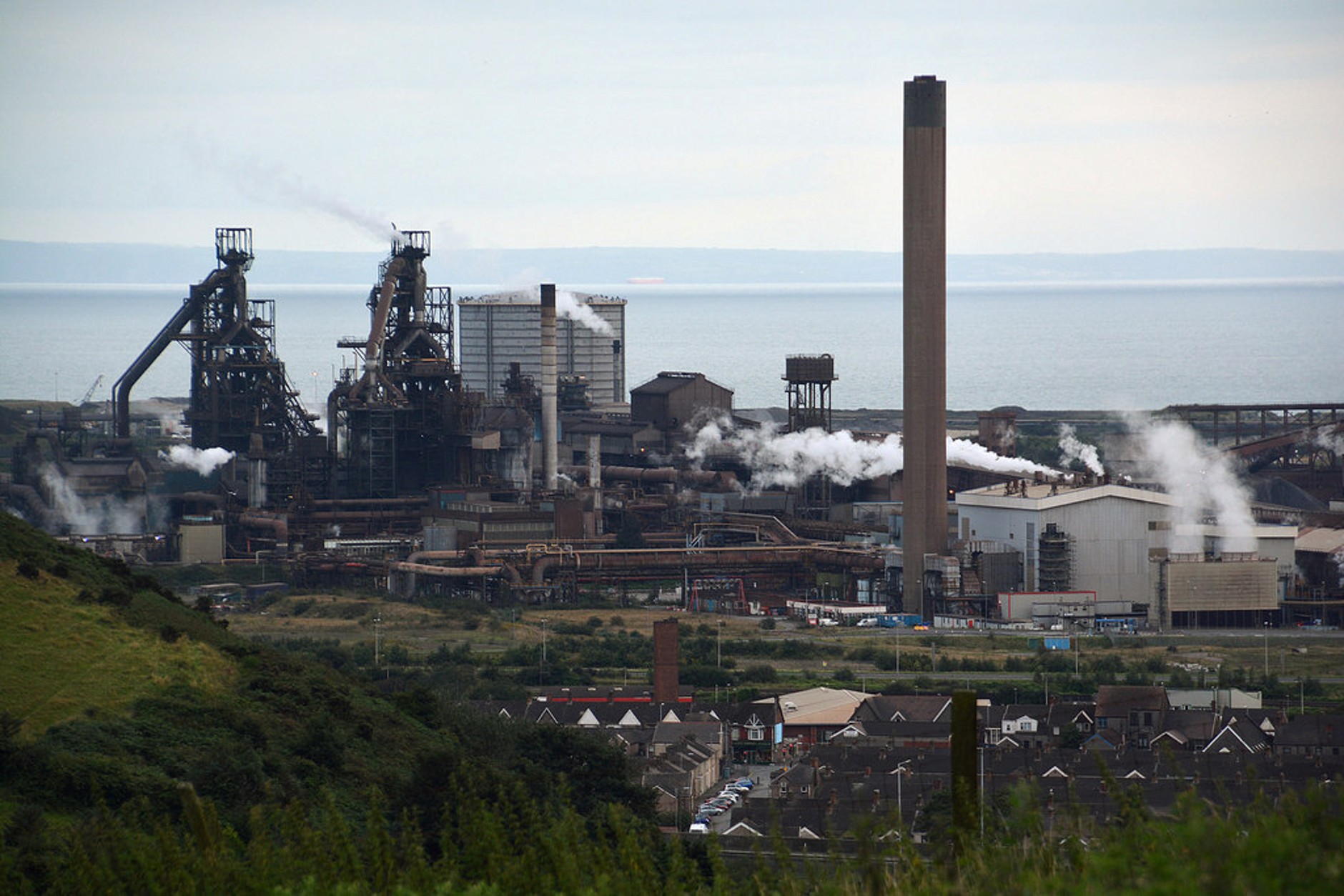
Port Talbot (UK) steelworks (pre-2025)
Same chemistry for 3,000 years
Humanity has been producing iron for over 3,000 years. Throughout that time, we have relied on a chemical process that has remained fundamentally unchanged across the millennia: using carbon as the reductant to turn iron ore into iron. That approach built the modern world. But humanity will need vastly more steel to build a low-carbon future and we cannot afford to make it the old way.
It’s time for a change.
Our Vision
What do you think of when you think about iron-making? A giant blast furnace belching out smoke and CO2 24 hours a day, unable to ever stop, to ramp up and down to meet demand, reliant on coal and subsidies, and ever-vulnerable to changing public moods on pollution and industrial support?
This is not our vision of iron-making. Our electrolysis technology uses electricity rather than carbon as the reductant. It is clean, quiet, scalable, and modular. As comfortable on a light industrial estate supplying a local additive manufacturing company with high purity iron as in a steelworks churning out the thousands of tonnes of fresh iron an electric arc furnace requires. Able to ramp up and down to meet demand, to take advantage of cheap renewable energy or even to attract demand side reduction payments.
Waste is feedstock
Then there’s the other side of iron-making, the side people rarely see or think about. Literal mountains of mine waste, millions of tonnes of iron ore rejected due to being incompatible with blast furnaces for one reason or another. Several times a year these waste mountains collapse, causing environmental disasters.
But we do not see these as waste, we see them as feedstock. We see our electrolyser at a mine site powered by its own solar and battery array converting this waste into valuable iron day after day, working its way through this virtually unlimited supply of otherwise unusable mud.
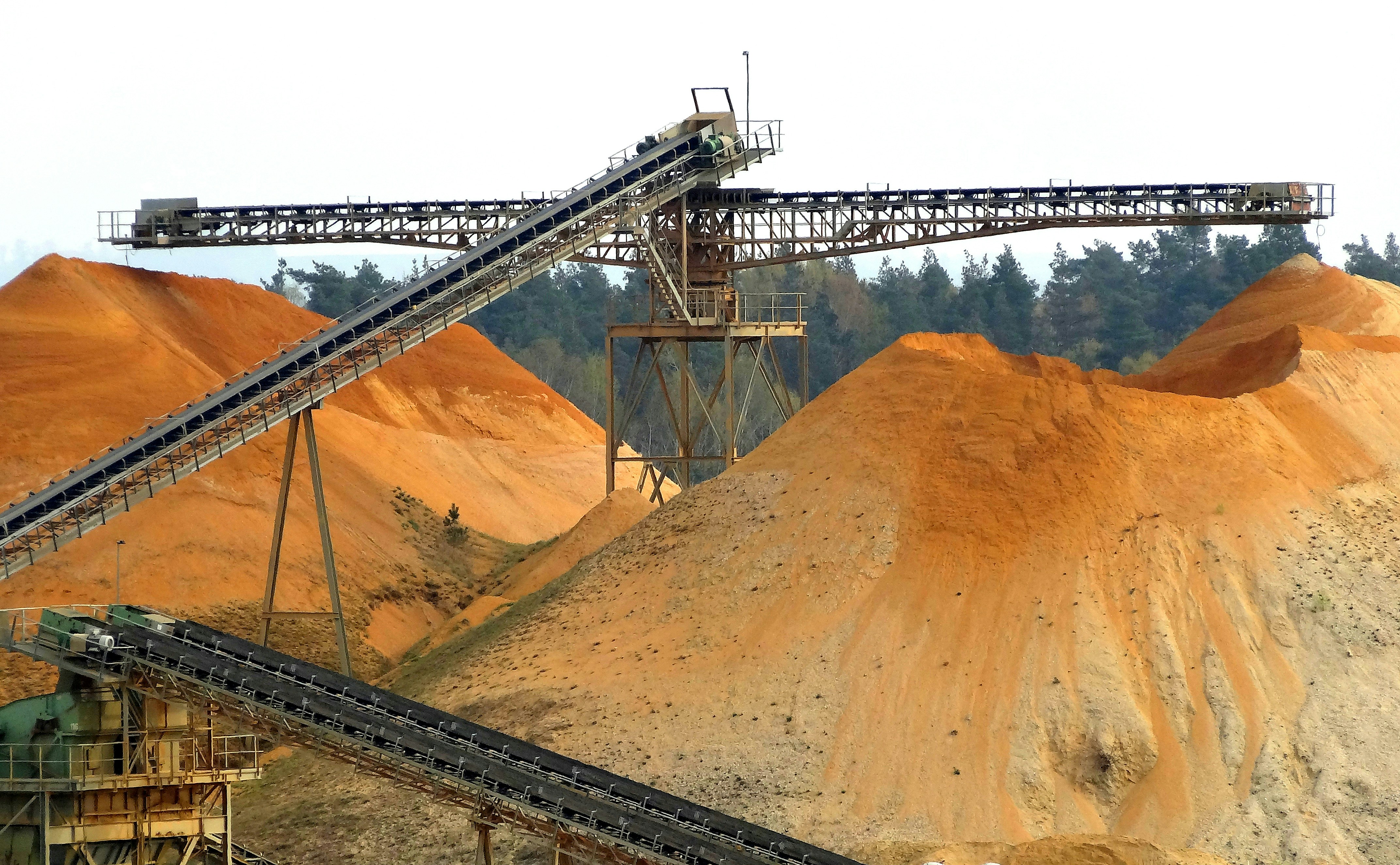
Iron-ore mine tailings facility
Our Solution
At Ironic Metals we are developing technology to produce clean, emissions-free iron at cost parity with the blast furnace. Our approach is to apply electrolysis to solve three unsolved problems in the area:
- Objective 1: Maximise process intensity (i.e. iron production rate per plant footprint)
This is vital in a commoditised industry where CapEx utilisation must be maximised. - Objective 2: Process compatibility with low-grade ores and mine waste.
By turning material that currently has no value into iron, we produce iron at lower prices than a blast furnace and simultaneously solve a significant environmental issue for the miners. - Objective 3: Minimising the CapEx of a scaled plant.
Technology where complexity means high cost of components will not scale for an industry working at the scale and low cost of iron production. We are focused on using cheap materials and commercially available components to keep CapEx to a minimum.
If we achieve even two of those three, we have a credible pathway to achieve cost parity with a blast furnace even at modest scales of production. Our strategy solves all three - we are targeting a production cost of less than $400 per tonne of iron.
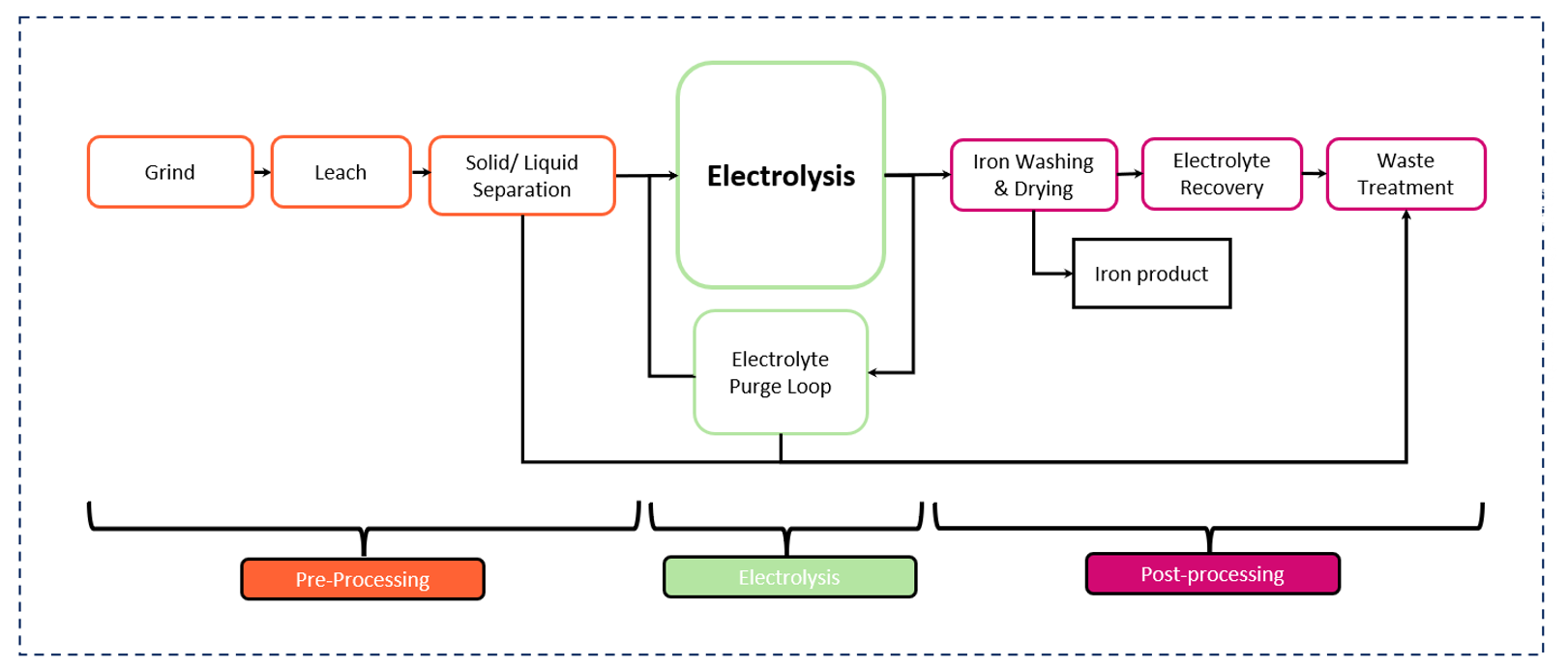
Ironic's process flowsheet
How it works - and what it costs
Electrolysis
The first pillar of our technology is the electrolysis of iron ore: electrical power is used to pump electrons into iron ore and pull the oxygen away, leaving metallic iron behind. This takes place as the following reaction in our electrochemical reactor:
2Fe2O3 → 4Fe + 3O2
Ironic’s proprietary electrode design accelerates this reaction to unprecedented rates, allowing us to maximise the amount of iron produced by each reactor, thereby maximising the process intensity (Objective 1).
A single modular electrolysis reactor processing high-grade ore runs at 2 V at 2.3 kA, producing 11 tonnes of iron per year at a 90% load factor. This gives the energy requirement per tonne of iron produced as ~3.3 MWh/tonne. For comparison, the blast furnace runs at ~3.8 MWh/tonne.
At today’s US industrial electricity prices of $0.08/kWh, the electrolysis power cost component is therefore $264/tonne of iron. Electricity prices should drop due to cheap solar power in the future; at realistic future value of $0.05/kWh, the power cost is $165/tonne. If the electrolyser is powered by its own off-grid solar farm, the power cost is effectively zero (the CapEx of the solar farm must be amortised, of course – see further down).
Pre-processing
The second pillar of our approach is our pre-processing technology. Iron ore mine waste contains high levels of impurities such as alumina and silica, which make it incompatible with blast furnaces. We remove these impurities by leaching the mine waste, separating the remaining, purified iron ore, and electrolysing it (Objective 2). High grade ores can be processed without leaching but do require grinding.
Feedstock cost
The cost of higher-grade iron ore is around $100/tonne.
Mine waste costs miners in storage and monitoring – this is effectively a free, or near-free feedstock.
CapEx contribution
We are designing our electrolysis reactor using cheap, readily available materials to keep CapEx costs down (Objective 3). We don’t use expensive membranes. We don’t use precious metals. Where possible, we build using commercially available parts.
The annualised CapEx contribution to the cost of iron depends on the plant size. For a 100,000 tonne/year plant, it’s $32/tonne, and for a 1 million tonne/year plant it’s $17/tonne, amortised over a plant lifetime of 20 years.
Other costs
The costs of post-processing and auxiliary costs come to $21-42/tonne. Labour costs of $19/tonne were calculated based on Humbert et al. and overheads were assumed to be 20% of labour cost (typical for water electrolysers, a similar technology).
Total cost of iron production
Global iron prices currently run at $350–450 per tonne. Our mine-waste route sits within or below that range at both power prices, and high-grade ore is competitive at $0.05/kWh – with no carbon price factored in.
Once the EU's Carbon Border Adjustment Mechanism (CBAM) is fully phased in by 2034, blast furnace iron in the EU is projected to cost $550–650 per tonne. Against that, our mine-waste route would be roughly 20–50% cheaper, and our high-grade ore route would be roughly 10-40% cheaper.
Cost of iron production at 1 Mt/year scale ($/tonne Fe)
|
High-grade ore |
Mine waste |
|
$0.05/kWh |
$0.08/kWh |
$0.05/kWh |
$0.08/kWh |
| Electrolysis |
165 |
264 |
210 |
337 |
| Pre-processing |
10 |
14 |
27 |
29 |
| Feedstock |
149 |
149 |
3 |
3 |
| CapEx contribution |
17 |
17 |
20 |
20 |
| Post-processing and other costs |
21 |
34 |
26 |
42 |
| Labour and overheads |
23 |
23 |
23 |
23 |
Total cost of iron
[$/tonne]
|
385 |
501 |
309 |
454 |
Given that electrolysis power cost is the dominant contributor to our cost (40-75%), what if our plant was powered by off-grid solar? Perhaps on a mine-site, thereby also saving on the transportation cost of ore, and allowing countries with iron ore mines to add value by exporting iron rather than iron ore.
In this case, electricity operating costs are replaced by amortised renewable generation capital.
Let’s say a 100,000 tonne/year plant processing mine waste is paired with a solar farm in Western Australia. This would require a 75 MW electrolyser facility combined with a 113 MW solar farm to run the electrolyser at a capacity factor of 35%. Assuming an installed cost for solar panels of $750/kW and installed cost for battery storage of $125/kWh, this results in a solar farm CapEx of $84 million. Amortising this CapEx over a plant lifetime of 20 years and assuming an 8% cost of capital results in an annualised capital cost of $8.6 million a year, or $86/tonne. Adding a non-electricity production cost of $130/tonne results in an iron production cost of only $216/tonne – far cheaper than a blast furnace.
Conclusion
We believe ironmaking is ready for a fundamental change. For more than 3,000 years, iron has been made by using carbon to remove oxygen from iron ore. That process built the modern world, but it is poorly suited to the world we need to build next.
Ironic Metals is developing a different approach: modular electrolysis that uses electricity instead of carbon to make iron. By combining high process intensity, compatibility with low-grade ores and mine waste, and a focus on simple, low-cost plant design, we believe it can produce iron without direct carbon emissions and at a lower cost than the blast furnace. Our technology could also make iron production more flexible, allowing plants to respond to the availability of renewable electricity rather than running continuously.
The opportunity goes beyond decarbonising existing iron production. It is about rethinking where, how and from what we make iron. We see a future in which iron can be produced next to mines, powered by renewable electricity, using material that is currently treated as waste, and in modular plants sized to the needs of their customers. If we are successful, the next 3,000 years of ironmaking will look very different from the last.
